
A colony by any other name
TetleysTLDR: The summary
A decade after the 2014 referendum, Scotland’s place in the UK looks less like a voluntary partnership and more like a managed dependency. Every major promise used to secure a 'No' vote: continued EU membership, economic stability, NHS protection, constitutional respect, all have been broken or reversed. Brexit was imposed despite Scotland’s clear opposition, Holyrood’s mandates for a second vote are ignored, and Westminster treats Scottish consent as optional while expecting perpetual contribution. The UK operates as a hierarchy with England at the top, Scotland a subordinate expected to provide resources but denied agency. When one nation repeatedly blocks another from even asking the democratic question, the relationship ceases to be a union and becomes a form of political control. Independence is no longer just an aspiration but a moral necessity: a nation’s right to govern itself cannot depend on the permission of another. Scotland has every right to walk away, and every reason to.
TetleysTLDR: The long bit
Back in 2014, Scotland was marched to the ballot box under the pretence of partnership. The people were told solemnly, gravely, and with the full political theatre of Westminster’s finest, that they were an equal nation in a family of equals. They were told their voice mattered, that their vote counted and that the United Kingdom was a voluntary union of proud nations bound not by coercion but by mutual respect. They were told, in short, a fairy tale. And just like every fairy tale, it fell apart the moment the lights came up and the credits rolled.
Eleven years on, the truth has settled in with all the grace of damp creeping under a skirting board. Scotland wasn’t courted in 2014, it was managed. It wasn’t persuaded, it was threatened, love-bombed, emotionally blackmailed and economically browbeaten. Every lever of the British state, from the press to the Treasury to the political class who couldn’t find Aberdeen on a map without a staffer was pulled not to illuminate the choice but to terrify the electorate into compliance.
Now, in 2025, as the last decade evaporated together with the promises faster than a single malt spilled on a hot stove, the case for Scottish independence stands not only renewed, but morally unanswerable. If a nation says ‘We wish to govern ourselves’ and another nation replies ‘No’, then what you have is not a union: what you have is a colony.
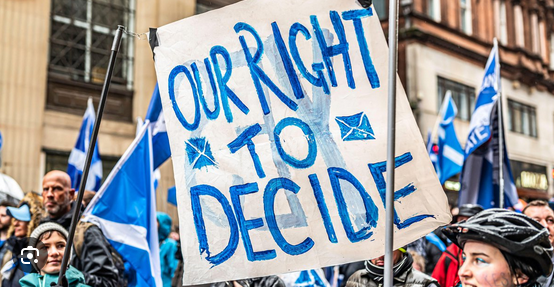
Since 2007, the Scottish National Party has held a clear and enduring mandate for independence in the Scottish Parliament. They first formed a minority government in 2007 on an explicitly pro-independence platform, won an outright majority in 2011, something the Scottish electoral system was designed to prevent and then continued as the largest party in 2016 and 2021, governing either alone or with Green support, with every election underpinned by a manifesto commitment to holding an independence referendum. In democratic terms, that is an unbroken 18-year mandate for Scotland to choose its own future. Yet this sustained parliamentary support has not translated into independence itself for one simple reason: Westminster holds the legal power to authorise a referendum, and successive UK governments: Conservative, Labour, and coalition have simply refused to respect Scotland’s repeated democratic choices. The Scottish Parliament can express a mandate, pass motions and elect pro-independence governments, but without Westminster consent or a fundamental change in constitutional strategy, Scotland remains trapped in a system where its democratic will is acknowledged at election time and ignored the moment ballots are counted.
The great British con
In 2014, the Scots were lied to. Not misled, not gently nudged, not given debatable projections - they were lied to, on an industrial scale: bare-faced and proudly by the same slick-haired Westminster salesmen who’d flog you a used car with no engine and swear it was mint condition. Scotland was told EU membership, something Scotland was far more supportive of than those south of the border, was safest with the Union. A year later, the British electorate was marched to the polling booth to wrench the whole UK out of Europe in an act of self-harm so floridly stupid it belongs in an Aesop fable. Scotland voted decisively to remain, yet woke up chained to the mast of the HMS Britannia as it steered itself gleefully into an iceberg. Scotland was told Scotland’s pound was secure, only to watch Westminster’s economic competence disintegrate like wet tissue. Scotland was told its oil wasn’t worth much, right up until London needed the revenue at which point miraculously it was worth plenty. Scotland was told the NHS would be protected by staying in the UK, a promise that now reads like a joke scrawled on the back of a beer mat. Scotland was told its place at the heart of the Union was precious, only to discover your supposed ‘partners’ barely remembered your existence until independence was mentioned again: at which point Scotland was were lectured, scolded and talked down to like a child who’d wandered into the adults’ lounge. A decade of broken promises. A decade of contempt. A decade proving that the 2014 referendum wasn’t a moment of national decision - it was an intervention, staged to keep Scotland in its place.
The Union that isn’t
What kind of union requires one half to beg for permission to even reconsider the arrangement? What kind of partnership allows one partner to call all the shots while the other is expected to smile, curtsey, and say ‘thank you kindly’? What kind of democracy tells a nation it is sovereign, then blocks any democratic mechanism that might demonstrate that sovereignty? The answer: not a union at all. The UK is not a union, it is a hierarchy and Scotland sits beneath England in that hierarchy, expected to obey, expected to contribute, expected to doff the cap and sit quietly while the real decisions are made elsewhere. Westminster likes to pretend the UK is four nations sharing one roof. In truth, it is one landlord with three tenants and only one of them gets to set the rent.
Powerlessness by Design
Scotland can vote however Scotland likes. It can and consistently has, elect an overwhelmingly pro-independence parliament. It can give mandate after mandate for a fresh vote. It can send MPs to Westminster who argue passionately for Scotland’s right to choose. It can shout from rooftops, from rallies, from the floor of Holyrood itself. And England can simply say: ‘No'. Not discuss. Not negotiate. Not agree a timetable or a framework or a democratic route forward. Just: ‘No'. If that isn’t colonial power logic, what is it? If that isn’t the posture of an imperial centre towards a subordinate territory, what term fits better? Because in what fantasy version of democracy does one nation get to veto another nation’s self-determination indefinitely? Imagine the shoe on the other foot. Imagine Scotland telling England it was not permitted to hold a vote on its future. The response would be volcanic, but England does it to Scotland and calls it ‘stability’.
Scotland: provider, never decider
The Great British racket depends on Scotland contributing: oil, energy, exports, labour, natural resources, strategic coastline but never actually deciding. Scotland provides wealth. Westminster allocates it. Scotland generates energy. Westminster sells it. Scotland elects governments. Westminster ignores them. You’re good enough to power the grid, to house nuclear submarines, to supply the Treasury, to provide the land and the labour and the logistics that keep the UK running, but when it comes to decisions about Scotland’s future, suddenly you’re too small, too poor, too insignificant, too emotional, too naïve, too unpredictable, too parochial: whatever patronising line is fashionable this week. This is the logic of a coloniser, your resources matter - your consent does not.
The Westminster ‘we own you’ mentality
Let’s be blunt. The current constitutional settlement is held together not by respect, or history, or shared identity, but by English entitlement. The belief that Scotland is England’s to keep. The belief that Scotland’s rejection of Tory rule is an eccentric regional quirk, not a democratic reality. The belief that Scottish self-government is dangerous, but English exceptionalism is somehow stabilising. The belief that the UK is England, with decorative attachments. It’s the same mentality that allowed Westminster commentators to sneer at Scottish aspirations, treating them as parochial, provincial, small-minded while simultaneously worshipping the ‘sovereignty of the British people’, by which they clearly meant English voters only. A partnership of equals? Really? If England decides, Scotland obeys. That’s not a relationship, that’s ownership.
Democracy: The line Westminster will not cross
The surest proof that Scotland is not treated as an equal nation is this: If Scotland were allowed a vote, Westminster knows how it would go and that terrifies them, because they know the mood has shifted. The lies of 2014 hang in the air like the smell of last night’s burned dinner. Scotland did its part. Scotland took Westminster at its word. Scotland voted in good faith and England repaid that good faith with Brexit, austerity, deregulation, collapsing public services, and a political culture so shameless it can barely look itself in the mirror. So now, the British state refuses to risk the question again. The democratic route is blocked, the political route dismissed, the legal route frustrated. If you can’t vote your way out of a union, it’s not a union, it’s captivity.
Economic Blackmail Masquerading as Concern
Westminster’s arguments against independence are always the same: Scotland can’t afford it. Scotland would struggle. Scotland isn’t ready. Funny, that. Scotland is apparently rich enough to keep the UK afloat, but too poor to manage its own affairs. Scotland is stable enough to underpin the British economy, but too unstable to run its own. Scotland is bright enough to provide world-class universities, industries and innovation, but apparently too thick to elect a competent government. It’s colonial logic dressed up as paternal concern: ‘You can’t leave, darling, you wouldn’t cope without me.’ But Scotland could cope. Scotland already copes with choices it didn’t make, governments it didn’t vote for and Westminster incompetence it never endorsed. Independence wouldn’t be painless. No separation ever is, but the claim that Scotland is inherently incapable is absurd, patronising and dripping in imperial arrogance.
The moral case: a nation can say no
The right to self-determination is not conditional on economic forecasts or on the comfort of the dominant nation. It does not depend on whether England approves, or on whether the City of London signs off on the spreadsheets. A nation is a nation because its people say it is. If the Scottish people want independence, that should be the beginning and the end of the matter, and if the English political class refuses to allow them to decide? Then they are declaring openly that Scotland is not sovereign. That Scotland is not equal. That Scotland is not a partner. Scotland, in their eyes, is something to be owned.
The political fear at the heart of it all
Why does Westminster resist? It isn’t economics. It isn’t practicality. It isn’t stability. It’s fear: fear of losing face on the world stage. Fear of losing the last fig leaf of Britain’s former grandeur. Fear of becoming a country that must finally confront its shrunken status without Scotland’s landmass, resources and geopolitical leverage. Fear that England alone looks a lot less like a world power and a lot more like a small, tired nation still cosplaying empire and most of all, fear that if Scotland walks away, Wales will reconsider, Northern Ireland will edge closer to unity and the whole British project will finally collapse under the weight of its own arrogance.
2025: The year the pretence finally shattered
A decade on from the referendum, it is 2025 and the Union is held together by inertia, denial and coercion. Every promise of the Better Together campaign lies in tatters. Every guarantee has dissolved. Every solemn vow is a ghost drifting over the ruins of a shared future that never truly existed. The Scots voted 'No' on a promise that the UK would change. The UK instead doubled down on everything that pushed Scotland toward 'Yes' in the first place. And now you have Reform UK Ltd pouring their toxicity into the mix. It is like an abused partner in a toxic relationship. So now, the case for independence is not just political, not just economic, not just cultural - it is moral, it is democratic, it is necessary and it is urgent.
A colony can always walk away
A nation cannot be held in a union by force, not without exposing the entire arrangement as a colonial relic dressed up in modern branding. Scotland asked in good faith to determine its future. England said it already had. Scotland asked again. England said no. Scotland may ask again. The answer will likely always be the same. At some point, it stops being a disagreement and becomes an indictment. If Scotland wants independence and England refuses even to let it ask the question, then Scotland is a colony: politically, constitutionally, and democratically and like every colony throughout history, Scotland has one inalienable truth on its side: A people cannot be denied forever.
The choice ahead
The time is coming when Scotland will have to decide whether its future is governed by:
- a parliament it elects, or one it endures;
- a political culture it shapes, or one that dismisses it;
- a national destiny of its own choosing, or one tethered permanently to England’s decline.
And Westminster will have to decide whether it is still the imperial centre pretending to be a partner or whether it is finally prepared to treat Scotland as an equal. But let’s be honest: Westminster won’t choose equality, it never has, It never will and it probably isn't even capable of doing so. Power never gives itself away voluntarily. It must be taken.
And so we arrive at the inevitable conclusion
If Scotland is a partner, then let it vote. If Scotland is sovereign, then let it choose. If Scotland is valued, then prove it. But if Westminster refuses, if the English state continues to veto, block, belittle and patronise, then Scotland must face the truth: It is not part of a union. It is subject to one. The chains on the unicorn are shackles and no self-respecting nation puts up with that forever, because if Scotland is a colony, then the only sane, moral, dignified answer is the one colonies throughout history have given their masters:
- We are done.
- We are not yours.
- We are leaving.
Who could blame them? And when that day comes, if Westminster doesn’t like it, it needs to understand it can shove its ‘union of equals’ right up where it keeps all its other broken promises, next to the dusty box marked integrity, untouched since about 1707.
Tetley is a left of centre writer and retired musician based in the UK. A former member of the Labour Party, he writes political analysis exposing Britain’s authoritarian drift, the criminalisation of protest, and the erosion of civil liberties.
A bit of shameless self-plugging here. This is www.TetleysTLDR.com blog. It's not monetised. Please feel free to go and look at the previous blogs on the website and if you like them, please feel free to share them.