
We need to talk about the Telegraph
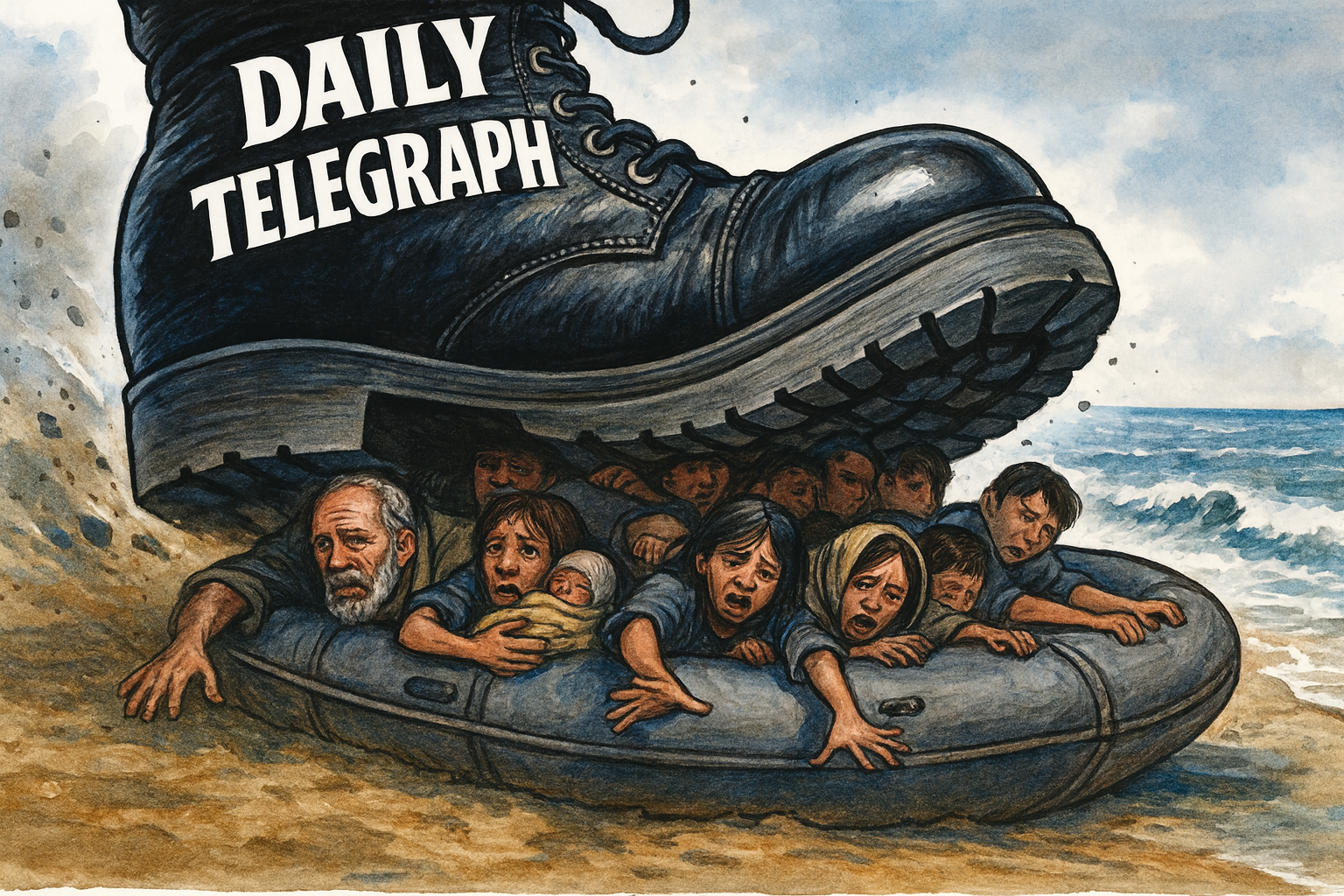
TetleysTLDR: The Summary
The Telegraph never lets a good stoking up of right wing fury get in the way of the truth. The UK does have a population and infrastructure crisis: but blaming ‘boat people’ is a con and blaming immigration in general is not much better. Yes, the population has risen to about 69.3 million and most of that growth since 2004 is linked to net migration, but small boats account for a tiny slice of this. In 2024 there were 43,630 detected irregular arrivals, most by small boat compared to hundreds of thousands of regular long-term migrants and millions of existing residents. The real story is this: governments hollowed out the NHS, social care, housing and water infrastructure through austerity, privatisation and planning failure, then pointed at migrants when everything started to break. Research shows immigration has little to no overall negative impact on UK wages or employment, and migrant workers are essential to the NHS, care sector and public finances. Our problem isn’t ‘too many foreigners’. It’s too many cowards in power and too many papers like the Telegraph running cover for them.
TetleysTLDR: The long bit
Philip Johnston’s piece, ‘LET'S STOP PRETENDING THE IMMIGRATION CRISIS IS ALL ABOUT BOAT PEOPLE. IT ISN'T’ (Daily Telegraph, online 18 November 2025; print 19 November 2025), is a textbook example of how the Telegraph stokes moral panic for political ends.
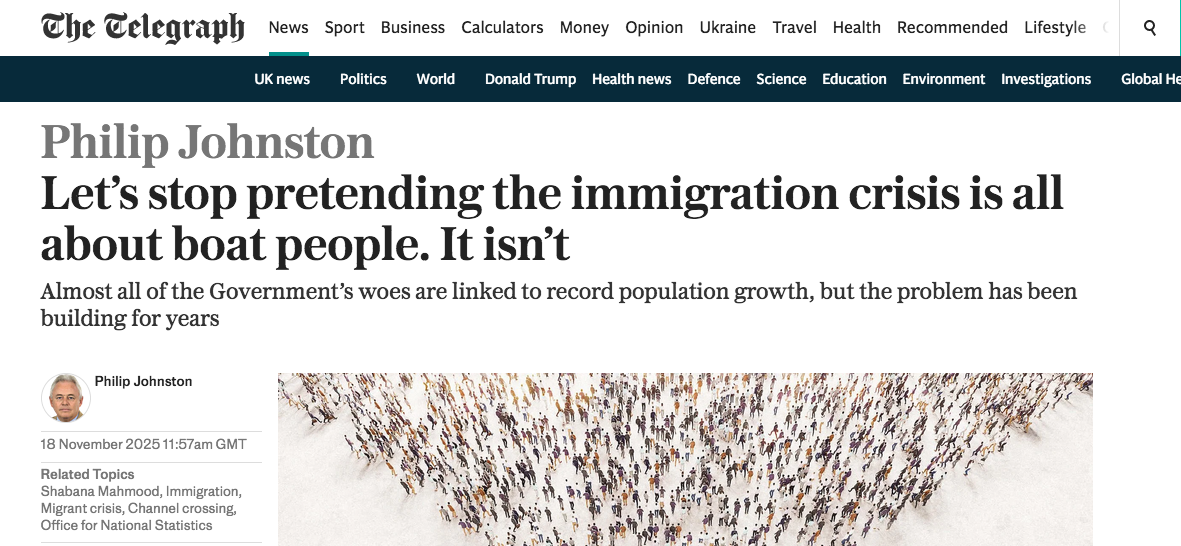
https://www.telegraph.co.uk/news/2025/11/18/stop-pretending-immigration-crisis-about-boat-people
It dresses up anxiety as analysis, turning a complex web of policy failures into a simplistic story about population numbers and 'uncontrolled migration'. This is the house style of a newspaper that has spent years drip-feeding its readers a steady diet of fear, encouraging them to see migrants, not austerity, not privatisation and not systemic political negligence as the architects of Britain’s crises. Johnston’s article isn’t just misleading; it’s part of a long-running propagandistic project in which the Telegraph helps manufacture outrage, launder far-right narratives into mainstream respectability and point public anger at the powerless instead of the powerful.
Johnston’s Telegraph piece gets one big thing right and almost everything else wrong. He’s right that something genuinely serious is happening in Britain, but it isn’t what his analysis claims and the villains are not the people in dinghies.
Start with the number that’s meant to shock us. The UK population is now estimated at 69.3 million (mid-2024), up by around 755,000 in a single year. Office for National Statistics That is fast growth by historical standards, and immigration now accounts for most of it. Between 2004 and 2023, about 65 per cent of population growth was a direct result of net migration. Migration Observatory.
Those are the facts. But what Johnston does next is the classic trick: he smuggles in a story about blame. A story where every broken service, every housing crisis and every queue in A&E is laid at the feet of migrants and, ideally, the most desperate and visible migrants of all: the people in small boats. Someone should call this out for what it is:
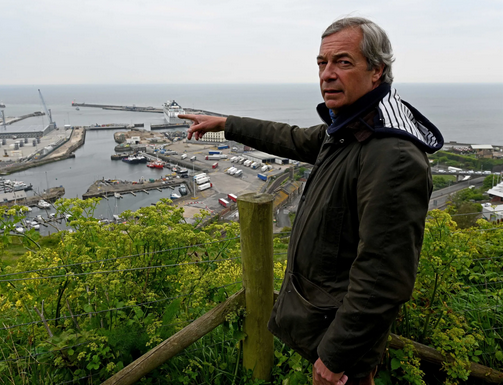
Nigel Farage pointing
Boat people are a sideshow that's deliberately made to look like the main event
If you get your politics from the Telegraph or GB News, you could be forgiven for thinking that most population growth and most migration is asylum seekers arriving on small boats.In reality, the small boats issue is a tiny fraction of the overall picture.
- In 2024, there were 43,630 detected irregular arrivals to the UK; about 84 per cent of them arrived by small boat. GOV.UK
- In the same period, long-term immigration was around 898,000 people. Office for National Statistics
- Only about 8 per cent of non-EU long-term migrants in the year to June 2024 claimed asylum at all. Office for National Statistics
So small-boat asylum seekers are a sliver of a small slice of the population: a minority of asylum seekers, who are themselves a minority of migrants, who are themselves a minority of everyone living here. Even the latest Commons Library briefing on asylum notes that in the year to September 2025 only 41 per cent of asylum seekers arrived on small boats and a further 11 per cent through other irregular routes; the rest came on visas and then claimed. Research Briefings. And yet in Johnston’s narrative, this sliver becomes the symbol of ‘almost all of the Government’s woes’. That isn’t analysis, it’s scapegoating with statistics as window dressing. If we were serious about numbers, we would be talking far more about:
- international students
- health and care workers
- people coming for work in sectors starved of staff
- the British-born leaving, especially young people driven out by low pay, high rents and zero security
But you can’t build a cheap moral panic out of radiographers and postgraduate students, so we get wall-to-wall small-boat porn instead.
And here’s the truth the Telegraph will never tell you: the reason there are small boats is because Britain deliberately shut down every safe and legal route for the very people who now wash up on our coastline in rubber inflatables. Before Brexit, many asylum seekers could travel through Europe under the Dublin system, which allowed claims to be made and processed without people resorting to smugglers. When we tore ourselves out of the EU, cheered on by the same Telegraph crowd — we ripped up those agreements and replaced them with nothing. Family reunion routes were tightened, resettlement quotas slashed, embassy processing virtually non-existent. In other words, we closed the door and then acted shocked when desperate people climbed through the window. Brexit didn’t 'take back control', it took away the last remaining legal pathways for refugees, leaving small boats as the only route of last resort. And the Telegraph will never admit that, because it would mean naming the real authors of this tragedy, the politicians and newspapers who engineered it: people like the Telegraph.

He's at it again - pointing. He does a lot of that
Net migration is already falling – but the panic is being dialled up
Johnston talks as if net migration is a runaway train. In reality, the latest ONS updates show a sharp fall from the peak.
- Revised estimates put net migration at 944,000 in the year to March 2023 – the highest on record, driven by post-pandemic catch-up, Ukraine and Hong Kong schemes, and a spike in study visas.Office for National Statistics
- By the year ending December 2024, net migration had already dropped to an estimated 345,000 after methods were updated – significantly lower than the earlier provisional 431,000 figure Johnston repeats. Office for National Statistics
So he is railing against yesterday’s data with yesterday’s talking points. The trend is already downwards – dramatically so. You can of course, and the far-right does, argue that 345,000 is still too high. You can even argue it should be zero, but you can’t honestly tell readers that the numbers are still exploding when the statistical agency has just reported the steepest fall on record. Unless, of course, your business model requires a permanent emergency. As the Telegraph's does.
But what about wages and jobs?
Johnston leans on the old claim that immigration has ‘undermined wages, closing off jobs to indigenous workers and crushing productivity’. It sounds plausible. It also happens to be almost entirely contradicted by the research. The balance of serious evidence as repeatedly summarised by the Migration Observatory and academic economists, is that immigration has small and mixed impacts on wages and employment, with no significant overall negative effect for UK-born workers. Migration Observatory Key findings:
- A major review for the Migration Advisory Committee found no significant evidence of immigration reducing employment for UK-born workers overall. GOV.UK Assets
- Studies of wage effects (including work published through the LSE) suggest immigration has little or no impact on average pay, with some downward pressure in particular low-paid sectors – pressure that is shaped far more by weak labour rights and union-busting than by who stands next to you at the production line. LSE Research Online
If employers can undercut wages using migrant labour, that is a policy choice:
- minimum wages set too low
- enforcement budgets gutted
- unions sidelined
- zero-hours contracts legalised and normalised
You don’t have to defend every aspect of free-movement-era Labour policy to see that the villain here is deregulation and employer power, not the passport of the person on the shop floor. Blaming immigration for low pay is like blaming fire engines for house fires because they always turn up at the same time.

Nigel Farage: a descendant of Hugenot refgees - who literally came here in small boats.. pointing again. He does like pointing
The real NHS story: migrants as staff, not saboteurs
Johnston waves vaguely at ‘crammed A&E departments’ as if they are a simple function of too many people, too quickly. Again, the evidence says otherwise. The NHS has been pushed into ‘critical condition’ by four main forces: austerity, the pandemic, poor management structures and a failure to involve staff and patients in decision-making. That’s the conclusion of the 2024 Darzi review for NHS England. NHS Confederation
Long before the current migration spike, research from the Nuffield Trust and Health Foundation showed that austerity after 2010 smashed waiting-time targets and eroded capacity.The King's Fund Subsequent work on patient flow shows pressures on bed space driven by rising multi-morbidity, squeezed bed numbers and delayed discharges: not a sudden tsunami of foreigners rocking up at A&E. NHS England
Meanwhile:
- Migrants make up a disproportionately large share of doctors, nurses and care workers. Migration Observatory
- Analyses of the NHS workforce consistently find that migrants contribute more in staffing than they take out in service use, especially at working age. The Health Foundation
The idea that the NHS would be magically fixed by slashing net migration isn’t just wrong, it is lethally wrong. Remove migrant staff and the system falls over by next Tuesday. Johnston’s argument is like staring at a hospital propped up by Filipino nurses, Ghanaian care workers and Romanian anaesthetists and deciding the problem is… too many foreigners. This is exactly the sort of polemic the Telegraph has made a living out of.
Housing, water, infrastructure: decades of political failure, not demographic shock
Then there’s housing. Johnston treats housing shortages and even water stress in the South East as simple side-effects of population growth. More people in, more demand; ergo, migration is to blame. Again, reality is messier and much more damning for Westminster. Parliament’s own research briefing on housing supply is clear: the UK has systematically failed to build enough homes for decades, held back by land values, planning constraints, speculative housebuilding models and underfunded local authorities. House of Commons Library
Academic work on the housing crisis talks about:
- an over-financialised housing market
- a collapse in social housing
- planning rules that favour big developers
- and more than a decade of austerity that shredded local government capacity.Science Direct
Yes, more people means you need more homes. But the choice to leave housing to a cartel of volume builders and buy-to-let landlords is not the fault of migrants. Nor was the decision to flog off council housing and fail to replace them or to treat housing as an asset class rather than a human right. Exactly the same is true of water and other infrastructure. The UK didn’t run out of reservoirs because a few more families arrived from Pakistan or Poland. We ran out because successive governments and privatised utilities refused to invest, preferring to shovel money into dividends while pipes leaked and sewage poured into rivers. You don’t get to ignore infrastructure for 30 years and then act surprised that a growing population puts it under strain.

Our NHS works because of it's international and migrant staffing model
What migration actually does to the public finances
Even if you ignore the human arguments and think only in terms of the state’s balance sheet, Johnston’s story is threadbare. Recent work by the Migration Observatory on the fiscal impact of immigration finds that overall, migrants in the UK tend to pay more in taxes than they receive in services and benefits, particularly recent migrants and those of working age. Migration Observatory
The Office for Budget Responsibility has repeatedly warned that an ageing society drives up pension and health costs, and that migration – because migrants are on average younger – reduces the old-age dependency ratio and eases long-term fiscal pressure. Office for Budget Responsibility
In other words:
- Without migration, there are fewer workers supporting more pensioners.
- The tax base shrinks faster, while health and social care costs rise.
You can’t run a Scandinavian-style welfare state on Singapore-style migration policy. Something has to give and it is never going to be the Telegraph’s share dividends.
The politics of pretending it’s all about numbers
Clearly, none of this means migration is cost-free. Rapid population change can strain local services, especially when central government has spent thirteen years stripping councils to the bone. It can reshape local culture, sometimes in ways people find unsettling. It can intensify competition in certain corners of the low-wage labour market but these are governable problems. You deal with them by:
- funding councils properly
- building public housing at scale
- regulating work and empowering unions
- investing in GP practices, schools and transport where need is high
Instead, Westminster chose a different path: cut services, deregulate work, hollow out local government, then point at migrants when the inevitable crunch arrived. That’s why the ‘system is broken’. Not because some Sudanese teenager in a rubber dinghy rocked the foundations of the British state, but because governments of all stripes chose to govern in the interests of landlords, outsourcing firms and newspaper proprietors and then used migration as political smoke. Johnston calls the failure to ‘stop this trend’ of migration ‘bordering on the criminal’. He could well be right, but again for the wrong reasons - if there is criminal negligence in this story, it lies with the people who froze public investment, flogged off assets, and pretended you could run a modern society on permanent austerity.

This is what the Telegraph does: stoke up anger and resentment - usually against the wrong people
So what would an honest debate look like?
An honest debate about population and migration might start with three simple truths:
- Yes, the UK population is growing and changing fast. That needs planning, investment and democratic debate. Pretending nothing is happening is as dishonest as pretending migration is pure poison. Office for National Statistics
- Asylum and small boats are not the main story. They are a symptom of a wider global crisis: war, climate breakdown, our own foreign policy, collapsing states and our decision to close safe routes. They are not the reason A&E is collapsing or your rent has doubled. GOV.UK
- The real crisis is political, not demographic. It is a crisis of underinvestment, privatisation and short-termism that would exist even if net migration were zero tomorrow. The King's Fund
That debate would still be fierce. People could argue for lower net migration, higher migration, or something in between, but at least we’d be arguing about reality rather than screaming at dinghies on the front page. Instead, we get Nigel Farage a man who has made an entire career out of pointing at foreigners and shouting and columnists like Johnston flattering him as a truth-teller while recycling the same threadbare myths. It is a racket, and it has worked for them for years.

What’s most striking about Johnston’s article isn’t what he says, it’s what he carefully avoids. Nowhere in his Telegraph polemic does he mention the elephant not just in the room, but sitting on the national chest: the rich have been strip-mining Britain for four decades ever since Thatcher tore up the post-war social contract and replaced it with a bonfire of public assets. You wouldn’t know it from reading Johnston, but the real story of modern Britain isn’t immigration. It’s extraction: political, economic and deliberate. Since the 1980s, successive governments have turned the British economy into a machine for siphoning wealth upwards:
- council housing flogged off without replacement,
- utilities privatised then loaded with debt while shareholders pocketed billions,
- rail, mail, energy and water transformed into cash cows for investors,
- the financial sector deregulated to the point of absurdity,
- wages deliberately suppressed, unions broken, and the tax system rigged in favour of asset-owners rather than workers.

So we need to talk about the Telegraph
The UK is not broken because too many people came here. It is broken because too many liars were put in charge. They slashed the NHS and blamed nurses with accents. They engineered a housing shortage and blamed the tenants. They underfunded councils, sold off water, squeezed schools and then told you it was all the fault of the people on the rubber boats. If we really want to ‘fix the system’, we should stop yelling at the passengers and start arresting the people who have been joyriding the bus for decades – the ministers, landlords, lobbyists and newspaper barons who built this mess and now point at migrants as human shields. Boat people are not the crisis. The real crisis is a political class – and a media ecosystem – that would rather scapegoat the vulnerable than admit its own guilt.
This is the great heist of our lifetimes. It’s why water bills soared while rivers filled with sewage. It’s why housing costs exploded while homes became mini-pension schemes for landlords. It’s why every essential service feels threadbare.
Immigration didn’t do that. Ordinary people didn’t do that. Refugees in dinghies most certainly didn’t do that. The architects were in Westminster boardrooms, City offices and cabinet rooms: drawing up the blueprints for a Britain run not as a society but as a portfolio.
Of course Johnston can’t go there, because to admit the truth would be to expose the deep complicity of the paper he writes for. The Telegraph has spent decades cheerleading for the very policies that hollowed out Britain: deregulation, privatisation, austerity, union-busting, tax cuts for the wealthy and the idiotic belief that markets solve everything. To point a finger at the oligarchs, hedge funds, multinational shareholders and rentiers who actually drained the nation dry would mean admitting that the Telegraph backed them every step of the way. So instead, the public are offered a pantomime villain: immigration. A ready-made distraction. A politically convenient decoy. A way of ensuring that people’s fury is aimed downwards at migrants - rather than upwards at the profiteers who engineered inequality on an industrial scale. It’s the oldest trick in the reactionary playbook: when the wealthy loot the future, blame the people at the border. Johnston’s silence on this is not accidental - it’s ideological, because if the public ever connected the dots, if they ever realised that immigration is being used as a smokescreen for elite predation, then the cosy arrangement between the Conservative establishment, the billionaire press and the extractive class would start to crack. Britain isn’t broken because too many people came here. Britain is broken because too many powerful people took too much for too long: and newspapers like the Telegraph helped them get away with it.
The Daily Telegraph isn’t just reporting on Britain’s problems, it is one of the institutions that created and sustained them. It has defended every destructive economic experiment from Thatcherism to austerity, cheer-led every privatisation that hollowed out our infrastructure, and given an uncritical megaphone to the anti-migrant rhetoric that keeps the public blaming the powerless rather than the powerful. When services collapse, when wages stagnate, when inequality yawns wider, the Telegraph’s instinct is not to question the politicians or billionaires responsible but to point the finger at refugees, EU nationals, anyone without a home in the world. It is part of the problem, not the solution: a paper that would rather frighten its readers than tell them who really emptied their pockets.
For decades the Telegraph has played ventriloquist to the Tory and Reform right, whispering panic into the public ear, laundering half-truths into ‘common sense’ and turning complex social failures into morality tales about migration. Johnston’s column isn’t journalism it’s the same old propaganda dressed in respectable broadsheet prose. It diverts anger away from the profiteers, the deregulators, the landlords, the privatisers, and points it squarely at migrants who had no hand in wrecking the system. In doing so, Johnston and his paper are not chroniclers of Britain’s decline but active participants in it: enabling the grifters, legitimising the far right, and making sure that the public keep blaming the people in the water rather than the people who pushed them there.
Tetley is a left of centre writer and retired musician based in the UK. A former member of the Labour Party, he writes political analysis exposing Britain’s authoritarian drift, the criminalisation of protest, and the erosion of civil liberties.
A bit of shameless self-plugging here. This is www.TetleysTLDR.com blog. It's not monetised. Please feel free to go and look at the previous blogs on the website and if you like them, please feel free to share them.